

For a few months now, Rovo has been enabled by default in every paid Cloud subscription to Jira, Confluence, Jira Service Management and the Atlassian Collections. Many of our clients discovered it one morning without asking for it: a new icon, a chat that answers, an agent that summarises a ticket. The natural reflex is to think "it's included, so it's free". That is not quite right.
"Included" does not mean "unlimited". Behind Rovo Chat, the agents and Deep Research, Atlassian has put a credit system in place, with precise rules on what consumes credits, what does not, and what happens when you go over. These rules change regularly; the latest announcement dates from 1 September 2026. Here is our summary, checked directly against Atlassian's official pages.
Rovo Atlassian pricing: the 1 September 2026 announcement
Until now, Atlassian did not bill any overage on standard Rovo credits, in exchange for a commitment: to give at least 90 days' notice before starting to bill.
That notice was triggered on 1 September 2026. Overage billing takes effect on 3 December 2026, for Rovo, Confluence, Jira, Jira Service Management and Bitbucket.
Overage is billed on the next invoice at USD 0.01 per credit (USD 10 per 1,000 credits), when usage-based billing is enabled.
Source: Atlassian's announcement on usage-based pricing.
Rovo credits: one shared pool per organisation
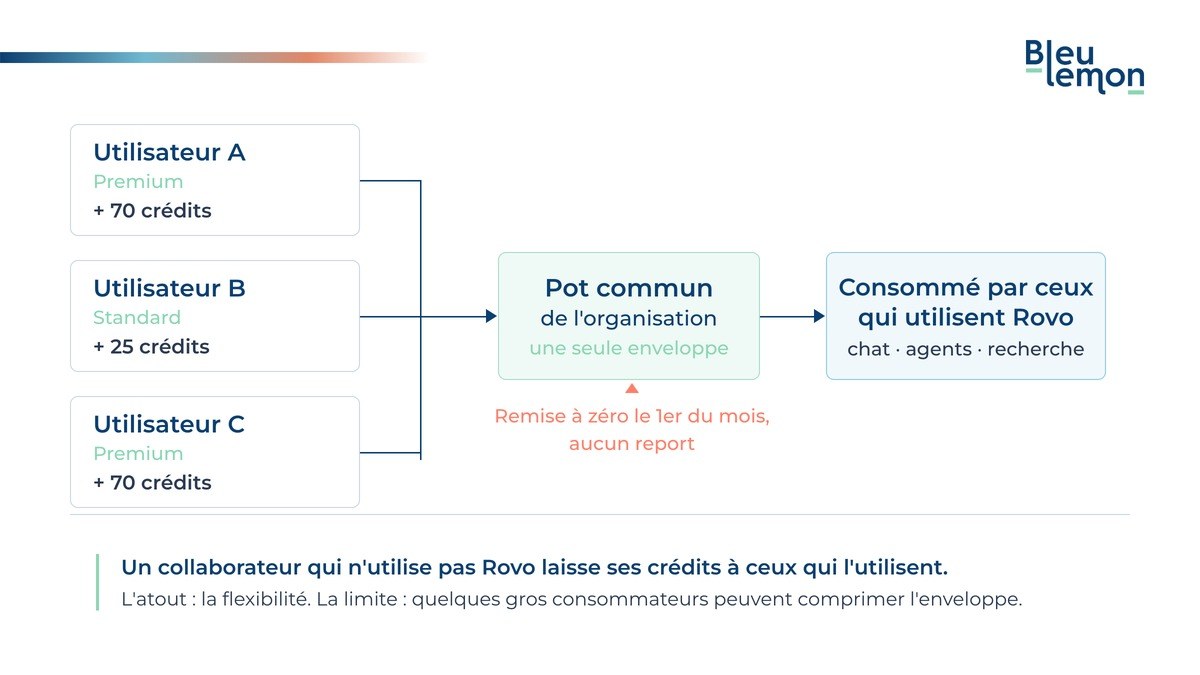
Rovo credits are not allocated to each user individually: they are pooled at organisation level.
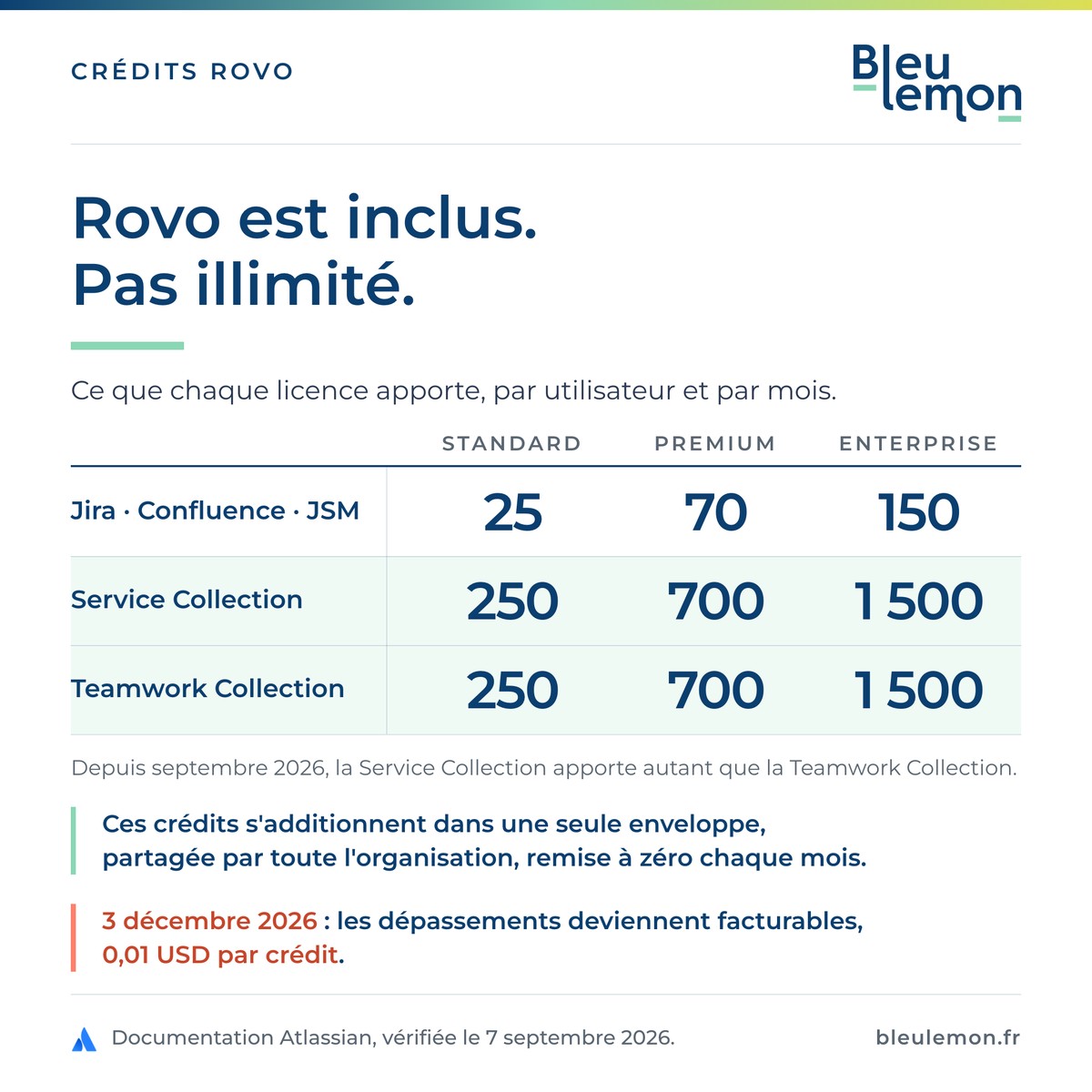
Each licence (Jira, Confluence, Jira Service Management, Teamwork Collection) brings a number of credits per user per month, and the total feeds a shared pool that the whole organisation draws on.
A colleague who never uses Rovo leaves their credits to those who use it more. A real flexibility advantage, provided you do not have too many heavy consumers at the same time.
These credits reset every month and do not carry over from one period to the next: a credit unused in June no longer exists in July.
What consumes Rovo credits, and what does not
Three levels, from free to costly:
Free: Rovo Search, automatic summaries, graph insights, definitions, and Atlassian Intelligence (rewording, suggested sub-tasks, ticket summaries in Jira and Confluence).
10 credits per request: Rovo Chat in quick-answer mode and the standard Rovo agents (called from Jira, Confluence or an automation).
Variable cost depending on complexity: Think Deeper (in-depth reasoning in Rovo Chat), Deep Research (multi-source research with citations), advanced agents, the Jira Coding Agent (code generation from a ticket), and AI slides in Confluence.
Alongside this, calls to the Teamwork Graph API (used by third-party tools to query your Atlassian data) follow their own logic: free for a simple search on a single product, between 1 and 10 credits for an enriched query that crosses several products.
Above all, remember this: an organisation can make intensive use of Rovo Search and Atlassian Intelligence without ever touching its credit pool, whereas Think Deeper, Deep Research and the Jira Coding Agent can make it climb fast.
How many Rovo credits do you really have?
Each user brings, per month, to the organisation's shared pool:
| Edition | Jira | Confluence | Service Collection | Teamwork Collection |
|---|---|---|---|---|
| Standard | 25 credits | 25 credits | 250 credits | 250 credits |
| Premium | 70 credits | 70 credits | 700 credits | 700 credits |
| Enterprise | 150 credits | 150 credits | 1,500 credits | 1,500 credits |
Service Collection and Teamwork Collection now offer the same allowance, ten times that of Jira or Confluence taken separately.
There is also Rovo Standard, a standalone offer that gives Rovo access to people without a paid Jira, Confluence or JSM licence. It is free during its current beta phase. At the end of the beta it will move to USD 5 per user per month, with at least 90 days' notice before switching to paid.
A concrete example: a 300-person mid-sized company, with 150 Jira Premium licences and 150 Confluence Standard licences, has (150 × 70) + (150 × 25) = 14,250 credits per month for the whole organisation. If every message sent to Rovo Chat costs 10 credits, that is 1,425 possible messages per month. Counting a typical conversation at 10 messages on average, the pool covers around 142 full conversations, or a mix of conversations, agent calls and a few Deep Research runs. Fewer still if a handful of users monopolise the pool with automations calling agents in a loop.
A second example, with a Collection: take the 150 people in that company who use both Jira and Confluence, the ones who until now held one Jira Premium licence and one Confluence Standard licence each. On their own, they generate (150 × 70) + (150 × 25) = 14,250 credits per month, as calculated in the previous example.
Because Teamwork Collection bundles Jira and Confluence into a single licence, those same 150 people now need only one Teamwork Collection Premium licence each, instead of two separate product licences. The pool then becomes 150 × 700 = 105,000 credits per month for that same group of users, a factor of more than 7.
On the same consumption assumptions (10 credits per message, 10 messages per conversation), that is around 1,050 Rovo Chat conversations per month, against 142 for the same group on separate licences.
Rovo Dev: a completely separate counter
Rovo Dev, the agent dedicated to developers (pull request review, code generation, codebase understanding), has its own credit system, independent of everything above.
Rovo Dev Free: 350 credits per user, per month, per Jira site. Once the quota is reached, Rovo Dev stops until the following month.
Rovo Dev Standard: USD 20 per developer per month, for 2,000 credits usable across all the organisation's sites. Beyond that, overage is billed at USD 0.01 per credit.
Rovo Dev has always been the only part of the Rovo ecosystem where overage is billed with no transition period. It is no longer an isolated exception: the rest of the ecosystem joins it from December 2026.
And if you exceed your Rovo credit quota?
This is the point that has changed most recently. Until now, Atlassian did not bill any overage on standard Rovo credits, in exchange for a commitment: to give at least 90 days' notice before starting to bill.
That notice was triggered on 1 September 2026. Overage billing takes effect on 3 December 2026, for Rovo, Confluence, Jira, Jira Service Management and Bitbucket.
Administrators still receive an alert at 80% and then 100% of the monthly pool. What changes from 3 December, three options:
Usage-based billing enabled: the service keeps working beyond the quota, and the overage is billed on the next invoice at USD 0.01 per credit (USD 10 per 1,000 credits).
Hard cap: an organisation that prefers a strict ceiling can disable this option in Atlassian Administration; paid features then stop until the next monthly reset, with no surprise invoice but with a risk of interruption mid-month.
Prepaid packs: prepaid credit packs (from 2,000 to 10,000,000 credits) remain a third option, at the same USD 0.01 per credit, with no volume discount identified to date.
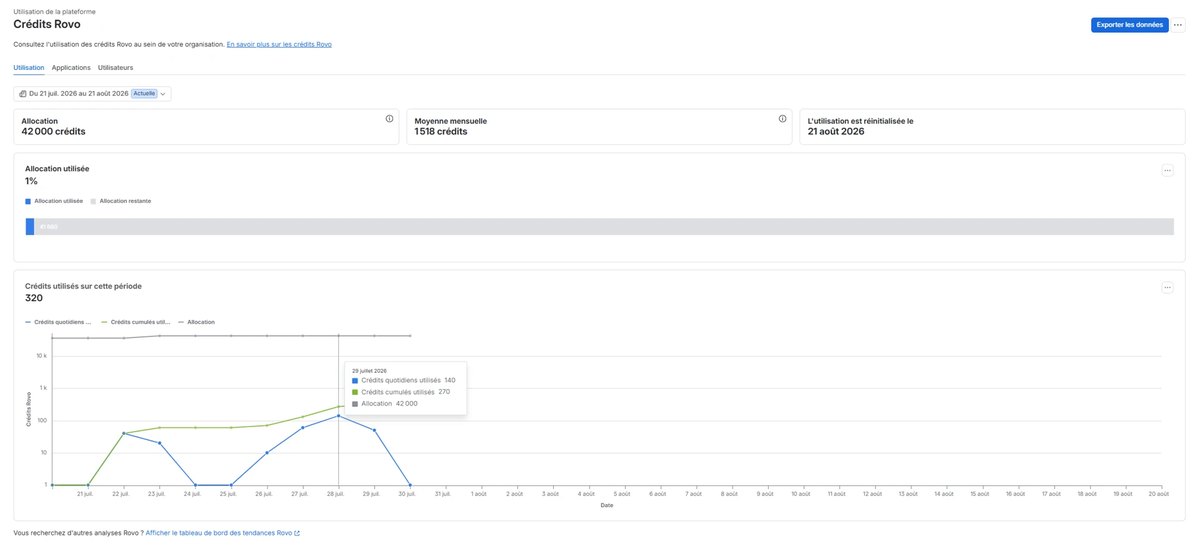
The Rovo Credits dashboard in Atlassian Administration, on our own organisation in July 2026: 42,000 credits allocated, 320 consumed over the period. This is where you read the trajectory, before the invoice.
What to keep in mind before rolling Rovo out widely
Overage billing has a date: 3 December 2026. The right time to measure your real usage and choose, ahead of time, between usage-based billing and a hard cap.
Rovo Dev follows its own, unchanged rule: overage billed since day one, to be watched if your developers use it daily.
Three variable-cost features deserve particular attention: Think Deeper, Deep Research and the Jira Coding Agent, harder to budget than a fixed price.
The shared pool is an asset, not a guarantee: a few power users or an automation running in a loop can empty it in a few days, with a real cost from December.
Service Collection and Teamwork Collection offer the same allowance, ten times that of Jira or Confluence alone: a genuine selection criterion for daily AI use.
On Standard and Premium, once Rovo is enabled for the organisation it is available to everyone: it cannot be restricted to a group of users; only the choice of applications can be managed upstream. On Enterprise, finer control exists: Rovo can be limited to certain groups through an allow list.
In practice: what to do before 3 December 2026
Before 3 December 2026, we recommend working out your real allowance (licences × credits per edition), checking your current consumption in Atlassian Administration, and deciding ahead of time between usage-based billing and a hard cap. It is a decision to take before the deadline, not after the first invoice.
This is typically the kind of subject we handle with our clients as an Atlassian partner since 2008: sizing AI usage before rolling it out, rather than discovering the invoice afterwards. If you are asking yourself the question for your organisation, let's talk.

Sources
Official sources checked on 7 September 2026: