

Article reviewed and updated by our Atlassian experts on 02 October 2025.
Only got a minute? Here is what your IT department needs to know:
-
Availability: Atlassian's AI is Cloud only (Premium and Enterprise plans). Data Center environments are not covered.
-
Rovo: The new AI agent "Rovo" widens the field of use by connecting to third-party tools (Google Workspace, Slack and others), breaking down data silos to relieve teams of time-consuming tasks.
-
Proven value: BleuLemon's concrete use cases show real gains: simpler JQL searches, faster customer support (JSM) and document intelligence in Confluence.
-
Prerequisites: The tool requires good-quality existing content (above all in Confluence) and a learning period for the teams.
-
Strategic risks: Successful AI integration requires a structured ecosystem, a considered position on data sovereignty, control over costs (Cloud, credits, activation) and the construction of use cases that are relevant to your organisation.
What is Atlassian Intelligence?
Named Atlassian Intelligence (the initials spell AI, you saw that coming?), it is a set of AI-based features. Powered by OpenAI models, it generates content and automates certain repetitive tasks to improve team productivity, but the current versions have significant limitations in French and on Data Center. Atlassian Intelligence is only available on the Cloud version of these tools (Premium and Enterprise plans only).
Atlassian Intelligence: AI is settling into the Atlassian ecosystem for good
Since AI took off at the end of 2022, many software vendors have built artificial intelligence features into their products. As early as 2023, the Australian vendor announced Atlassian Intelligence, a suite of AI tools built directly into its flagship products Jira, Confluence and Jira Service Management.
Since our last analysis in 2024, Atlassian's AI ecosystem has changed considerably. Beyond the Atlassian Intelligence features embedded in Jira Software, Confluence and JSM, the arrival of Rovo marks a strategic turning point.
Rovo is a powerful tool that acts at once as a conversational agent, an intelligent search engine and an assistant able to automate repetitive tasks. Its strength? Exploring and cross-referencing data from the Atlassian tools, but also from more than 50 third-party applications (Google Workspace, Microsoft SharePoint or Slack) through dedicated connectors.
This is precisely where our consultancy BleuLemon comes in: aligning tools, data and teams for smooth, measurable adoption, in the service of genuine change management.
Atlassian's promise is simple but ambitious: to help teams work more easily and more effectively. Not every team is covered yet, however, since Atlassian Intelligence and Rovo are available only on the Cloud versions of the Atlassian tools.
At present, only the Cloud Premium and Enterprise plans give access to these AI features.
Atlassian Intelligence is not available on Data Center, but for the users concerned, rest assured, we know how to deploy other solutions that bring artificial intelligence into their processes.
Atlassian Intelligence: concrete use cases among our clients
To understand better how Atlassian's AI fits into the work of teams, here are a few simple, concrete examples drawn from feedback from BleuLemon clients who already use Atlassian Intelligence. They show how AI is used day to day by teams that have genuinely built it into their work, with its advantages but also its limits.
Jira Software: goodbye complicated JQL, hello natural language search
On a Jira instance with a long history and a growing team, finding tickets can quickly become a real headache, particularly for newcomers.
Basic search soon reaches its limits, and mastering JQL (Jira Query Language), which supports advanced searches through functions reminiscent of SQL, is not always straightforward.
Between the operators, the date filters and the translation of criteria into Jira fields, many people can feel lost.
This is where Atlassian Intelligence steps in to make searching simpler. You describe what you are looking for in natural language, and the tool automatically generates the matching JQL query, in French as well as in English.
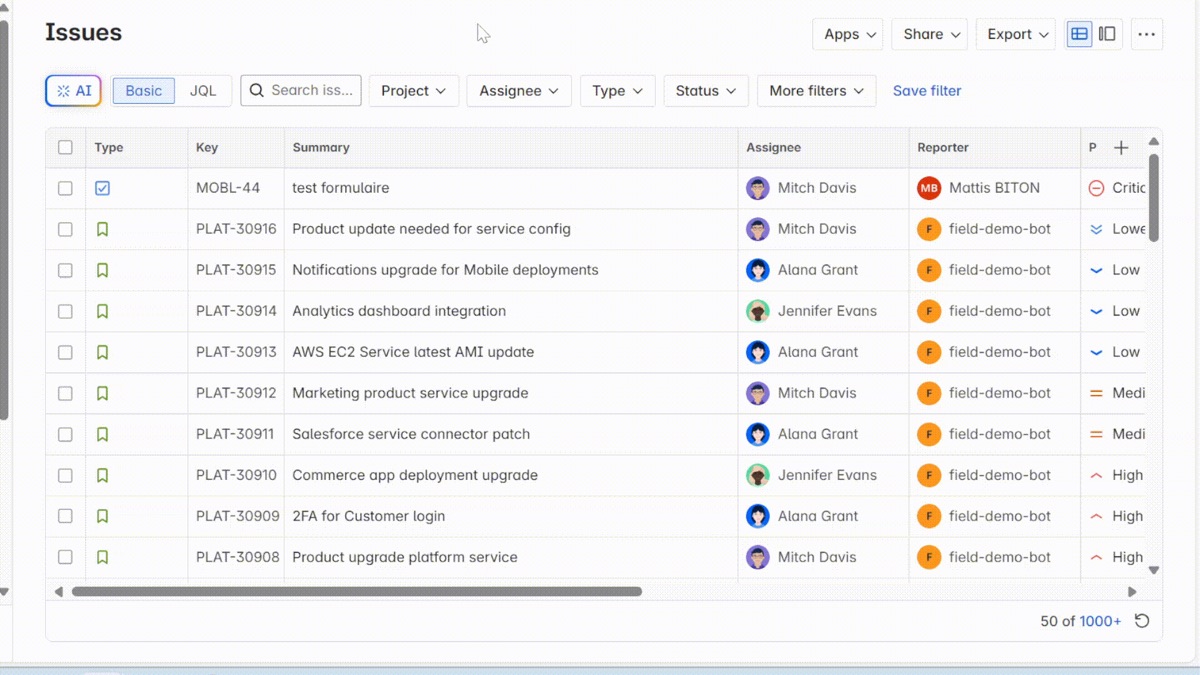
AI good practice in Jira Software:
We find that the tool gives better results when the request is worded precisely.
For example, rather than saying "Show me the assistance SRs" to display support service requests, which stands little chance of producing the right result, you will get something more relevant by asking "Show me tickets of type 'DS Assistance'". Be as exhaustive as you like, include keywords and iterate through different prompts until you reach a convincing result.
At this stage, though, you already need to know the structure of the tickets, the types, the fields in use, in short to be comfortable with the subtleties of Jira.
And once you are there, you are no longer quite the audience this Atlassian Intelligence assistant was built for. Even so, this AI feature in Jira remains particularly useful for handling specific criteria, such as date ranges, which are often awkward to manipulate by hand.
Jira Service Management: AI in the service of IT support teams
For one BleuLemon client in the insurance sector, the operational challenge facing the customer support teams is handling a high volume of urgent tickets of very different kinds. Faced with that heavy load, the AI built into Jira Service Management improves the overall efficiency of the support service (speed of handling and quality of responses).
Two uses stand out in particular:
-
Suggested standardised responses: when an agent opens a ticket, the AI automatically analyses similar requests handled in the past. It then proposes a template response, which the agent can approve, personalise or enrich. This mechanism cuts handling time and improves the consistency of responses.
-
Summaries generated for complex tickets: for a long ticket, or one with multiple exchanges and several stakeholders, the AI can generate a contextual summary.
That makes it easier for an occasional contributor to pick the ticket up (escalation to level 3) without rereading the whole history, while assuring them that they have not missed anything essential.
Finally, we should not forget the arrival of the conversational agents offered by Rovo, which open the way to a proactive customer support service that is smoother and more decentralised.
We will come back to this in detail in a future article.
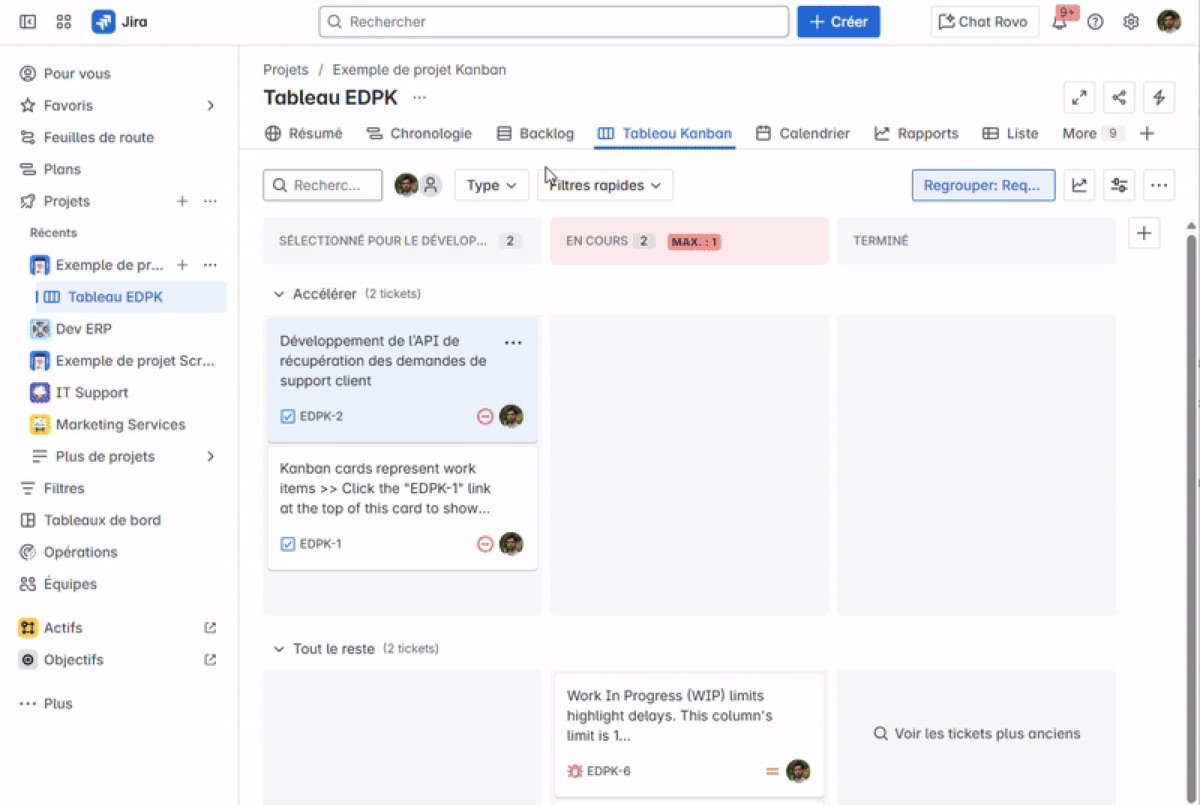
Confluence: smarter documentation, with no extra effort
At a software vendor that BleuLemon supports, the user documentation is structured in Confluence, tied to the features of the products. The Product and Support team keeps it up to date continuously.
The built-in AI delivers several very concrete gains here:
-
More accessible search: end users can ask questions in natural language ("How do I get access to a specific feature?") and the AI points them to the relevant page, without depending on the internal taxonomy or on precise keywords.
-
Automatic summaries: for long or highly technical documents, the AI generates a summary at the top of the page. That allows quick reading and better navigation, particularly when onboarding new users.
-
Faster writing: product teams can lean on the AI to generate page drafts, rephrase explanations or make the tone consistent. That reduces content production time with no compromise on quality.
What you should know before starting out with Atlassian's AI
Bringing AI into the Atlassian tools raises several points to watch and anticipate.
Data sovereignty
Because the data is processed in the cloud, it is important to assess the sovereignty and compliance stakes, particularly in sensitive organisations.
-
Secure channel: Every data request made to Atlassian Intelligence is sent individually to OpenAI, over an encrypted SSL service, to be processed and returned to Atlassian.
-
No external storage: Atlassian guarantees that OpenAI stores neither the data submitted (prompts) nor the responses generated. The flow is purely transactional.
Manual activation (opt-in)
Atlassian Intelligence can only be used if you switch the option on. It requires an explicit action by the administrator, which guarantees that no AI processing takes place without prior consent.
Administrators have the power to restrict access to Atlassian Intelligence for the sites and products of their choice.Access security is guaranteed, because Atlassian Intelligence inherits and rigorously applies the existing permission model.
Budget tracking for Atlassian licences
Some features, such as those offered by Rovo, rely on a credit system. That model can make consumption hard to anticipate and calls for rigorous budget tracking. Keeping control of your licence costs is not only a matter of watching the credits, but of avoiding a proliferation of low-value automations in order to concentrate on those that have a real impact on standardised workflows.
It should also be borne in mind that these tools are still recent. The benefits can be real but gradual, and their impact is not necessarily easy to measure.
Finally, the potential for development remains significant, but the right use cases for your organisation still have to be built.
Calling on our certified Atlassian experts
Integrating a technology such as Atlassian Intelligence is a technical project, but above all a lever for transformation.
At BleuLemon, our expertise as an Atlassian Platinum Partner lets us support you with a proven methodology that guarantees the tool is aligned with your strategic objectives. Our 3 stages:
-
Assessment
We identify your most profitable use cases before we start, for maximum ROI. -
Deployment with your teams
We guarantee adoption of the tool through tailored support that frees up your people's creative capabilities. -
Governance
We optimise your Atlassian licences to rationalise your investment. If you wish, we track the performance of your tools over the medium term, for lasting value.

Article update history
-
September 2025: Added detail on Rovo and on use cases among BleuLemon clients following Atlassian's latest announcements.
-
March 2024: News of the release of the first version of Atlassian Intelligence.