
- Ticket volume does not measure the performance of an IT support team. A ticket always signals a problem that has already been felt. The best ticket may well be the one that never existed...
- Users do not remember how fast a problem was resolved, they remember the absence of a problem. Nobody celebrates a ticket closed in twenty minutes. People remember, for a long time, a day when everything simply worked.
- "Zero tickets" is a false objective. A drop in volume can mean users who no longer know how to ask for help, who work around the process, or who have lost confidence in their support team.
- Tickets, SLAs and backlog are still necessary, but they are no longer enough. They steer the activity, not the quality of the service delivered. Satisfaction surveys, for their part, do not tell the whole story either.
- Three indicators are missing from most support dashboards. The number of problems avoided, the number of users who found an answer on their own, and the number of work interruptions removed by prevention, knowledge or automation.
For more than ten years, I have supported organisations through the transformation of their support services. I have seen projects succeed, others fail, tools change, methods evolve. But one thing has always struck me: the same questions come back, whatever the company or the tool being used.
"Why do we still measure the performance of a support team by the number of tickets?"
"We have a lot of tickets to handle."
"We have finally managed to bring our backlog down!"
"Since we moved to our new ITSM tool, ticket volume has risen sharply."
These are sentences I hear very regularly across my engagements. And I understand perfectly well why.
For years, the ticket was the heart of support. It let us organise teams, structure processes, measure activity and demonstrate the performance of service desks.
So no, I am not saying the ticket is a bad thing. Quite the opposite. But I do wonder whether we are not still, at times, measuring support with yesterday's indicators... while our objectives have changed profoundly.
Because when I talk with a CIO, a support manager, a team lead, or with a team in charge of steering, they never tell me: "My ambition is to create more tickets."
What I do hear very often is this:
"I want to improve the experience of my employees."
"I want to simplify the user journey for raising requests"
"I want to reduce work interruptions."
"I want users to regain confidence in support."
And that is where I find the gap interesting.
We talk more and more about user experience... but we still very often steer support as if the ticket were the end goal.
For a long time, that made sense. Support was essentially reactive: a user hit a problem, opened a ticket, a team picked it up and resolved it within the SLA.
The ticket was therefore an excellent unit of measurement.
Today, the context is changing. Knowledge bases are maturing and spreading more widely. Data has become the sinews of war. FAQs are better built. Portals are becoming more intuitive. Automation is progressing. Artificial intelligence is opening up new possibilities. In other words, we have more and more ways of solving a problem... before a ticket is ever created.

What if that were precisely the real evolution of support?
The best ticket may well be the one that never existed. That sentence can sound provocative. Yet it captures fairly well what I observe in the field.
The user experience without a ticket
Imagine an employee running into a connection problem. They open a clear knowledge base, find the answer straight away and are back at work in under two minutes.
No ticket: the employee gets back to work without waiting.
No handling time: support teams can concentrate on higher-value work.
No SLA: because there is simply no request left to handle.
And yet the result is an excellent user experience, built on autonomy and responsiveness.
Conversely, a ticket closed in twenty minutes within the agreed commitments is still... a ticket. It means a user had to interrupt their work, look up how to contact support, explain their problem, wait for an answer, then pick their activity back up.
Let us be honest, that user is probably not going to open their ticket with a smile. They are interrupted in their work, sometimes irritated, they cannot always explain their problem, and above all they want one thing: to get back to what they were doing as fast as possible.
At 20 minutes, we can say support was effective and responsive. But could this situation have been prevented from happening at all?
What stays with people is not the speed, it is the experience
Some time ago, I was served in a restaurant in a way I still remember today.
And yet it is not because the waiter was particularly fast.
It is because everything felt simple, natural, effortless. He anticipated our needs without ever being intrusive. We had a wonderful time.
The amusing part is that a year later, in a completely different restaurant, we recognised each other.
Not thanks to the speed of the service.
Thanks to the experience we had shared.
And I often tell myself that support ought to leave exactly the same memory.
Nobody says to themselves: "Wow! My ticket was handled in twenty minutes!"
What people do remember, for a long time, is a day when everything simply... worked.
The false joy of having no more tickets
Be careful, though, not to fall into another excess. I do not believe in the myth of "zero tickets". A drop in ticket volume is not necessarily good news. It can mean users who no longer know how to ask for help, who work around the process or, worse, who have lost confidence in their support team. Tickets, SLAs and the backlog will remain essential indicators for steering an activity.
And I am not convinced that our satisfaction surveys tell the whole story either...
On their own, these indicators are no longer enough to measure the quality of the service delivered.
New questions for measuring performance
What if we had simply forgotten to measure what really counts? Perhaps it is time to complete the dashboard with other questions.
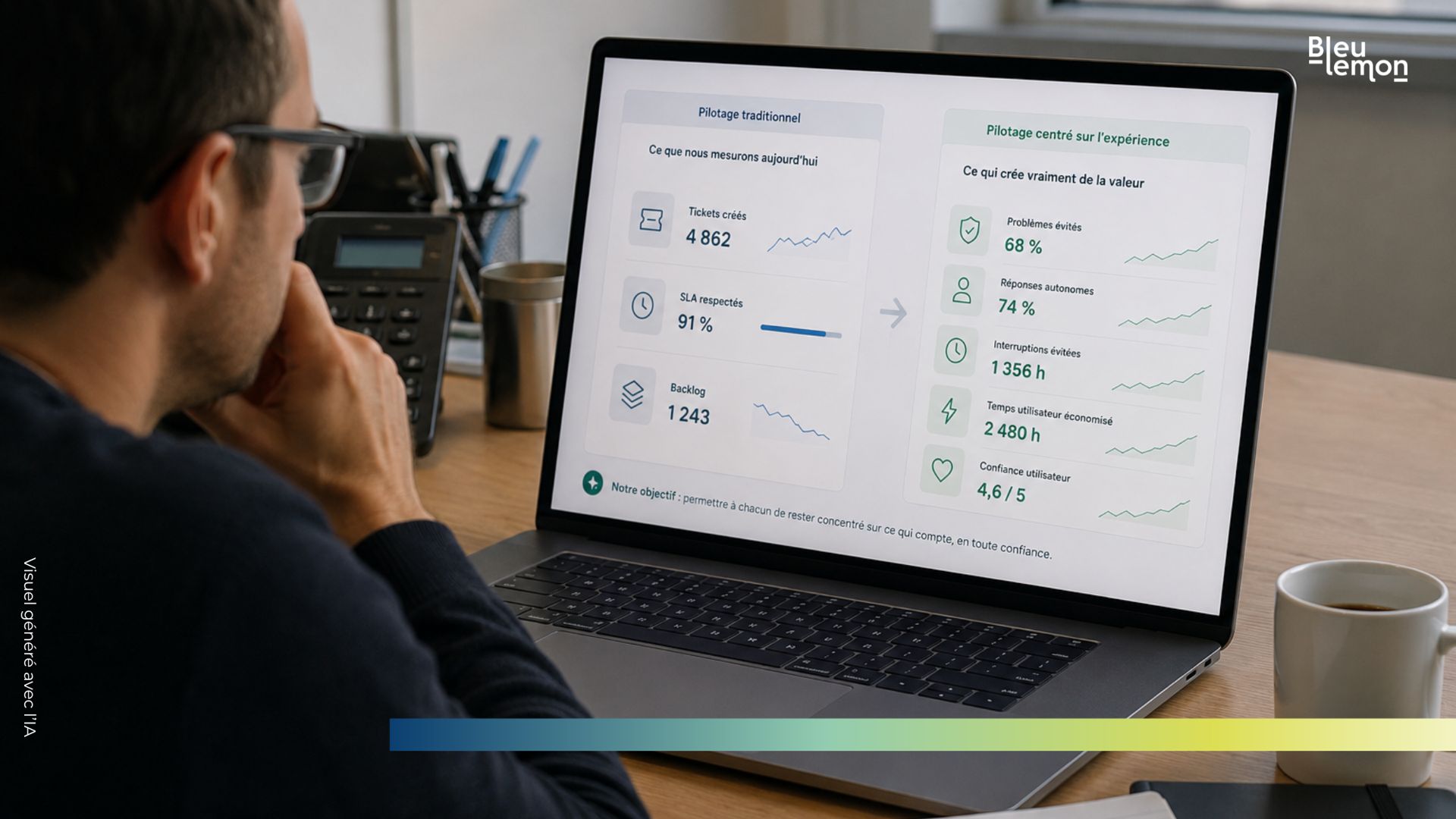
How many problems have we avoided?
How many users found an answer without calling on support?
How many work interruptions have we removed through prevention, knowledge or automation?
In the end, the ticket tells a story. The story of a problem that has already had an impact.
The user experience tells a completely different story. The story of every problem the user never had to live through.
And I believe it is precisely that story the support teams of tomorrow will have to learn to measure. In the next article, I suggest we take this reflection further with another question that comes back to me often on engagements: is the user portal still the best way into support... or has it become a reflex we no longer dare to question?
Vision Support 2030 is a series of articles in which Gwendoline shares her observations from the field, her convictions... and above all the questions a consultant asks about the evolution of support and of the user experience.