
RAG in one minute for your IT department:
-
Generic AI models (LLMs) lack business context and can "hallucinate".
-
RAG indexes your internal data to create a living reference base.
-
It is an effective system for obtaining answers that are reliable, up to date, contextualised and specific to your organisation.
-
It rests on fast vector databases that encode and search your data.
-
LLMs draw on your data without any retraining.
-
It is trustworthy AI, applied to your own expertise.
1. What is retrieval-augmented generation, or RAG?
RAG, short for retrieval-augmented generation, is the acronym now found in every AI project.
RAG intelligently connects the power of LLMs to your internal knowledge bases. It enriches large language models with your specific expertise to create an intelligence aligned with your business stakes.
To do so, the system queries a reliable external database, separate from the initial training datasets. It retrieves the relevant information and injects it into the context of the user's query, before generating the answer. This is the stage at which an organisation brings in its own business data and its sector expertise.
This reduces costly retraining; the AI draws on your knowledge to deliver answers aligned with your own concerns.
But this promise hides a considerable challenge that the BleuLemon teams observe in the field: most enterprise data is unstructured, held in Word documents, PDFs, emails and presentations.
The real issue is therefore not RAG itself, but the preparation of the data that feeds it.
Cheaper than fine-tuning, RAG relies on your document base, which must be of high quality if the answers are to be precise, consistent and useful.
2. How does RAG address the intrinsic limits of LLMs?
Large language models are the AI technologies that power advanced chatbots and the applications able to understand and process human language. But these solutions, far removed from traditional approaches, carry intrinsic risks that BleuLemon helps IT leaders work around by preparing your document databases for use by AI.
Standard LLMs, delivered "off the shelf", are powerful but imperfect tools because they work probabilistically: they can produce variable and unpredictable answers. More critically still, their knowledge base is frozen at a given date, which creates a gap with current events unless they are connected to an online search.
At BleuLemon, our strategic partnership with IBM, recently strengthened by the certification of 4 of our consultants on IBM Watsonx Orchestrate, gives us a clear view of the limits you are seeking to work around.
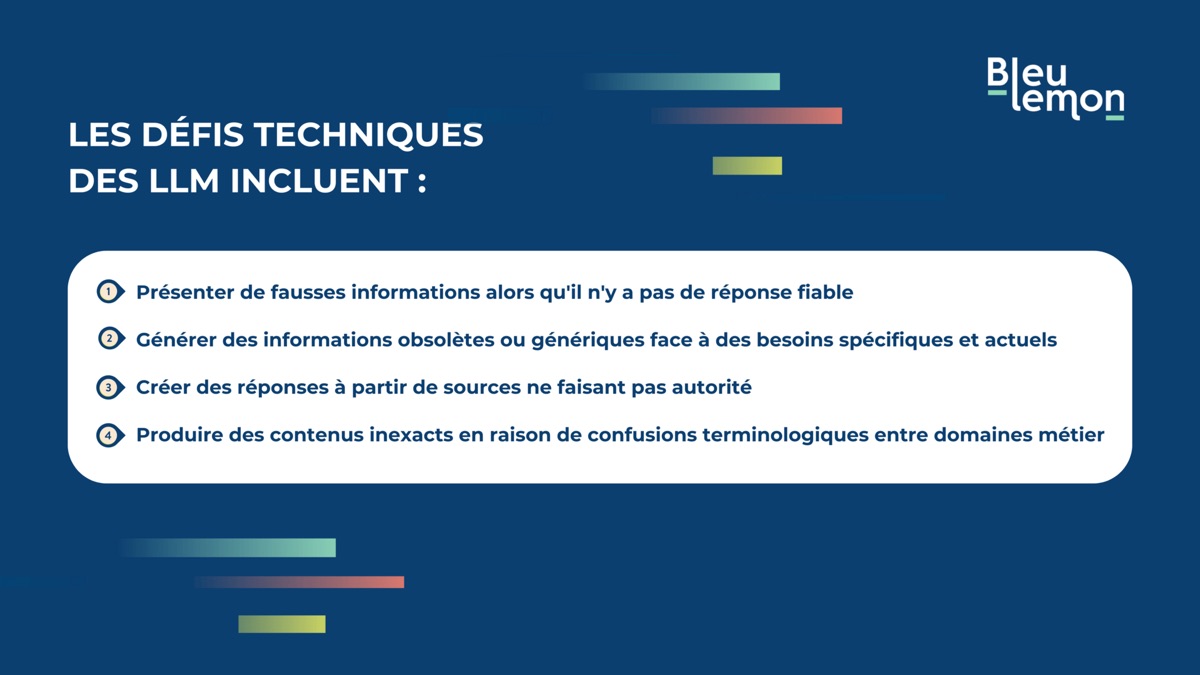
The technical challenges of LLMs that RAG seeks to solve:
-
Presenting false information (the famous "hallucinations") when it has no reliable answer.
-
Generating outdated information, or generic information, in the face of specific and current needs.
-
Building answers from sources that carry no authority.
-
Producing inaccurate content because of terminology confusion between your business domains.
RAG corrects some of these problems, in particular the unpredictability and obsolescence challenges. It intelligently redirects LLMs towards your validated, authoritative knowledge sources, with monitoring of the retrieval logs. It acts as a safeguard by forcing the LLM to base its answers on your validated documents, bringing essential traceability and control.
You can think of an LLM as an over-enthusiastic new employee who refuses to keep up with the news, but who will always answer with absolute confidence. That behaviour can have a negative impact on user trust. It is not something you want your systems to imitate!
3. The success of a RAG project: preparing your data
The solution lies in the quality of the data supplied to the system. It is a strong conviction that we share at BleuLemon. What is more, IBM's figures leave no room for doubt: good integration of unstructured data improves the accuracy of RAG models by 40%.
It is to reach that level of excellence that we have formalised a pragmatic approach, drawn from our experience in the field.
4. Robust solutions with RAG
RAG guarantees business consistency, and organisations keep granular control over the generated text output through document curation and similarity scoring. As for users, they get a view1 of the way the LLM produces the answer.
The BleuLemon method for preparing documents for RAG
To turn your raw data into reliable fuel for AI, we have structured our support around four essential pillars:
-
Detect sensitive or non-compliant content: Ensuring the security and compliance of information before it even enters the system.
-
Plan the clean-up and archiving of outdated content: Guaranteeing that the AI relies only on information that is up to date and relevant.
-
Structure the document databases for AI: Turning your documents (PDF, Word and others) into a format the models can understand and use effectively.
-
Refresh document governance: Putting in place the processes that keep your knowledge base reliable and effective over the long term.
The first step, and the most strategic one, is therefore not to launch a technical POC, but to assess objectively the maturity of your document estate.
If you would like to discuss the first stages of this assessment, we are at your disposal for a substantive conversation.
1 display of the documents and passages used for each answer.