
- The transformation of an IT department can succeed when the vision is shared
- An assessment dares to name the obstacles and reveals the hidden potential
- Collective support creates a systemic dynamic of buy-in
- An authentic and committed approach multiplies the impact of the change
- Lasting impacts are measured in well-being and in performance
- A successful change leaves a positive cultural imprint
1. The shared challenge of any transformation
Beyond technology
I am convinced that we are all living the same story. It is the story of a modern IT department facing a contradiction: investing heavily in technology without winning the user buy-in it hoped for.
At BleuLemon we see it every day. Substantial budgets, state-of-the-art tools, and a few months later adoption is nowhere to be seen.
Why? Because we forget one truth: transformation is not a question of tools or of skills. It is a question of meaning. Behind every process, every system, every line of code, there are teams, interactions and people who give a shared purpose to the use of those tools.
So what are the symptoms of a poorly thought-out transformation?
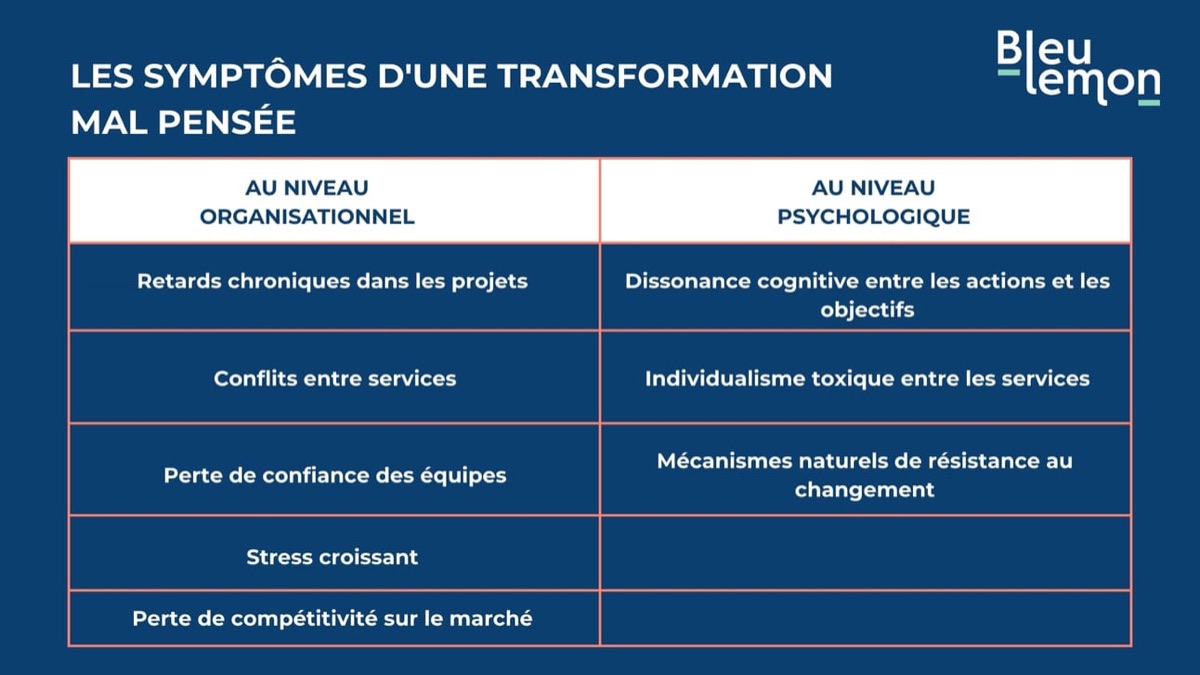
The symptoms of a poorly thought-out transformation
A striking example?
One situation in particular stays with me: at a software vendor, a company of around 250 people, the teams were split between the technical side, development and testing.
When he arrived, the new development director showed a great deal of enthusiasm. Armed with his successful experience at another software vendor, where he had enthusiastically put a successful approach in place. Naturally, he wanted to reproduce that success in his new company.
On the surface, everything seemed to be going well. In meetings, people nodded politely. Talking with the teams, I understood their frustration when one of the employees said to me: “We have been doing this job for 12 years and now we are told we do not know how to work?"
The pill was hard to swallow. Some were even ready to sabotage the project, simply to make their position heard.
Faced with this situation, I proposed a different approach. Instead of forcing the change through, I suggested pausing the project. I used that time to go and meet each team, immersed in their work. I wanted to understand their daily reality, their aspirations, the things they were proud of.
I asked them simple but essential questions: "What do you enjoy about your work? What are you proud of? If you could change one thing, what would it be?"
The conversations were extraordinarily rich. And the most fascinating part? The solution that emerged from those discussions looked very much like the one the development director had envisaged in the first place. The big difference? The solution came from the teams themselves. That ownership changes everything: adoption happens naturally, without resistance.
This experience confirmed a deep conviction: the success of a change does not depend only on how relevant the solution is, but above all on the way the teams are involved. Even the best idea can fail if it is imposed without regard for the people concerned. Conversely, when teams take an active part in building the solution, the barriers fall away by themselves.
And there lies a fundamental truth in change support: symptoms of resistance are never isolated or trivial cases. They reveal a deeper imbalance between individuals, their environment and their perception of the change. A careful analysis of these signals is what makes the real internal dynamic of the organisation understandable.
That understanding is essential to starting a transformation that aligns naturally with the values and the objectives of the company. This is where the whole subtlety of change management lies: it only truly takes shape when it answers human needs and strategic stakes at the same time.
2. A different vision: a more human IT
We hold a strong conviction: a different IT, more human and more sustainable, is possible. That transformation begins with a well thought-out approach, far from the traditional rigid frameworks.
What are the three pillars of change support with BleuLemon?
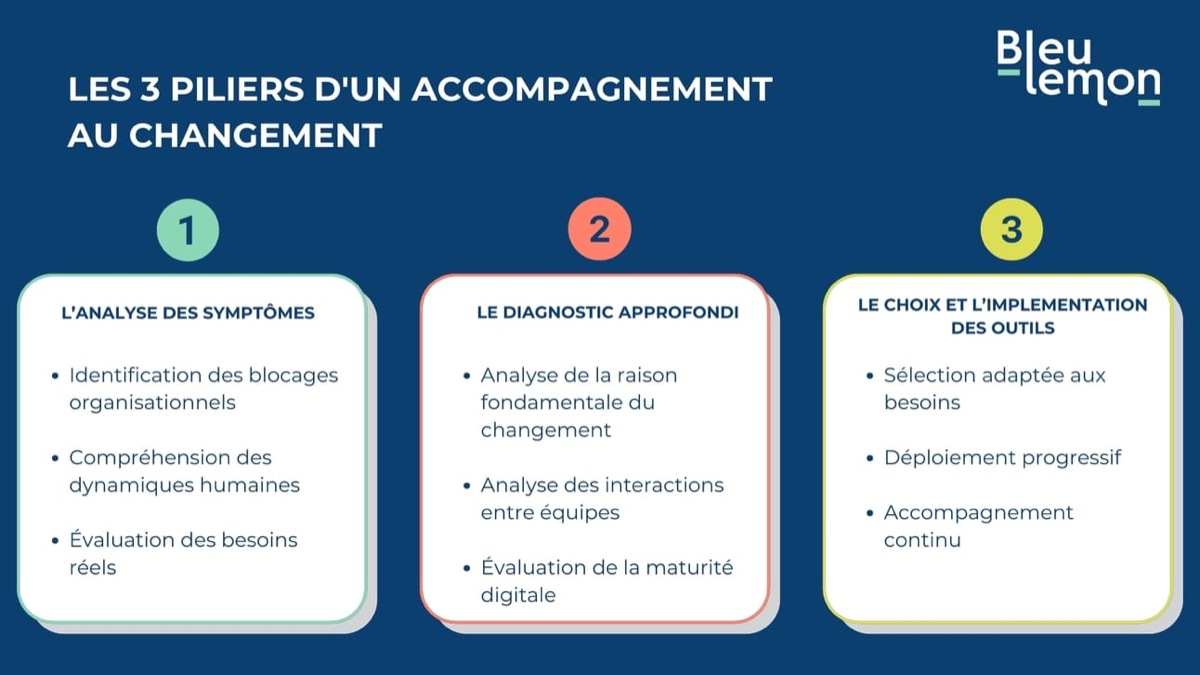
The three pillars of change support
BleuLemon's multidisciplinary team, passionate about the transformation of organisations, is the bedrock of our expertise.
Each expert brings a stone to the building: Mathieu Truchot, Olga Campeis and Gwendoline Gonzalez, for example, put their command of Jira at the service of agile and effective project management. Knowledge management and knowledge sharing are optimised thanks to the Confluence expertise of Soukayna Kouider and Vanille Sibide.
As for Jean-Christophe Denis and Idnan Sajid, they deliver centralised and agile management through their sharp expertise in Matrix42 and in ITSM (IT service management).
This complementarity of skills allows us to offer our clients complete, tailor-made support.
3. Our collective approach to your transformation
I firmly believe that every digital transformation is unique. But they all share the same architecture of success.
Phase 1: active listening and assessment
We enter your organisation with a single certainty: you know your daily challenges better than anyone. Our method combines:
-
Participatory workshops
-
One-to-one interviews
-
An in-depth analysis of existing practices
"I thought I had a tool problem; I discovered it was above all a question of communication between teams."
Phase 2: co-construction and alignment
Together we build your vision of success, working on:
-
The alignment of individual and collective objectives
-
The reduction of organisational silos
-
Stronger cross-team communication
Phase 3: change support and tooling
Our support does not stop at the technical rollout. In practice, our team:
-
Trains your managers on the new tools
-
Adjusts processes according to feedback from the field
-
Provides continuous support through our experts.
This three-phase approach, from active listening to co-construction and support, reflects a deep conviction of ours: a successful transformation is above all a collective adventure.
It is not a fixed process, but a living approach that adapts to your context and to your specific stakes. Our role is to be at your side to catalyse the energy of change while respecting the DNA of your company. Because in the end, the finest success is the one that comes from within, carried by the teams themselves, committed and aligned towards a common goal.
4. The shared imprint of a transformation: lasting results
A successful transformation mobilises an entire ecosystem. We create synergies between:
The internal teams that carry the change
-
The technology partners that make it possible
-
The clients who benefit from it
-
The managers who orchestrate it
Six months after our engagement, the results speak for themselves:
-
Teams take ownership of the new tools naturally
-
Managers report a new dynamic
-
Overall performance improves for the long term
-
The company culture shifts towards more collaboration
This ecosystem approach does not aim merely at short-term improvements, but at a deep transformation that holds over time.
That lasting imprint is what gives our approach its full meaning: seeing organisations transform, not under the effect of an outside intervention, but through the collective mobilisation of their ecosystem.
The success of a digital transformation lies in this capacity to create a movement that sustains and amplifies itself, carried by everyone in the company.
Let us build your transformation together
As the head of BleuLemon, I commit personally alongside every client. Our values are not just words on our social media. They guide each of our actions, every day.
Are you asking yourself questions about your transformation?
Let us share our visions and build a more human and sustainable IT together.
It is in co-construction that we create the conditions for a successful change.
BleuLemon supports IT departments through their transformation with freshness and quickness of mind. We help organisations release the collective potential of their teams, opening the way to a stronger and more fulfilling organisation of work.