
- Ten years of IT engagements as a consultant leave their mark. Quentin Bellego, an experienced consultant, shares here what you never read in an assignment brief: the blurred beginnings, the blunders, the real lessons learned in the field.
- A human account of a profession in constant change, between hybrid working, the arrival of AI, and client expectations that keep growing more complex.
- Learn to tell a hands-on consultant from someone who merely executes, and avoid costly mistakes, thanks to 10 years of experience in the field.
A few days ago I was updating my CV in the BleuLemon format. Scrolling back through my past engagements, I found myself reliving memories, the good ones and the less good ones. And I thought it might be worth sharing all of that. Not as a complete guide to "the consultant’s job", but to offer a very personal point of view, with its failures, its shifts and what I take from it today.
My early days in the job: a blurred role and unspoken client expectations
Arriving in the consulting world, especially straight out of university or after a career change, is rarely clear.
The title “consultant” does not mean very much. IT consultant? Functional analyst? Business analyst? Digital transformation consultant?
The vagueness starts with the business card.
And yet that vagueness is precisely part of the job: understanding a situation, navigating the grey areas, adapting to the client, and sometimes guessing what is expected of you when nobody really says it.
I started in 2012, freshly graduated, parachuted into a tower block at La Défense, in a suit and tie and shoes that were too big, waddling like a penguin.
My first desk?
→ A table shared with two other contractors, in a closed office on a rather empty floor, for an engagement lasting several months with no great ambition. I was young, keen and, above all, slightly lost.
Ten years later, I have changed a little, and so has the job.
Adopting hybrid working in my job as a consultant
What has changed most in consulting is the relationship to work itself. Back then you had to be on site, every day, full stop.
Today, engagements are often run in hybrid mode.
We travel for the moments that matter: kick-off meetings, workshops, training sessions. The rest happens remotely, on video calls, asynchronously, from a home office or from the BleuLemon offices. And to be honest, I would find it hard to go back. Since I have had a family life, that flexibility has been priceless. It does come with other constraints: managing your availability, staying professional without being physically present, setting clear boundaries. It is a different balance to build.
AI, cloud, Scrum and so on: tools and methodologies are redefining the transformation consultant’s role
The technology landscape, the methodologies and the regulations all keep moving.
When I started, I had never heard of cloud, artificial intelligence, GDPR or ITSM. Today I talk to ChatGPT almost every day. I generate audit frameworks, I rewrite meeting notes, I test ideas. And I can feel that this raises questions internally as much as it does at the client.
For example, it is entirely possible that, over the coming months or years, a client wanting to configure a workflow or implement a business rule in Jira will skip the consultant and ask Rovo to do the work directly.
Why call in a consultant if an AI can churn out a deliverable? Questions of environmental impact and of confidentiality arise with these tools too, even if personally I try not to become too dependent on AI, and I anonymise everything, out of fear or ignorance, before entering a prompt.
The answer, I think, lies in what we add on top: critical judgement, listening, putting things in context, the real experience of past engagements and human contact. But you also have to stay alert, everything moves fast, and to remain credible you have to keep learning and keep watching the market.
For me, expertise today lies largely in the ability to adapt.
Learning to get it wrong (and staying credible)
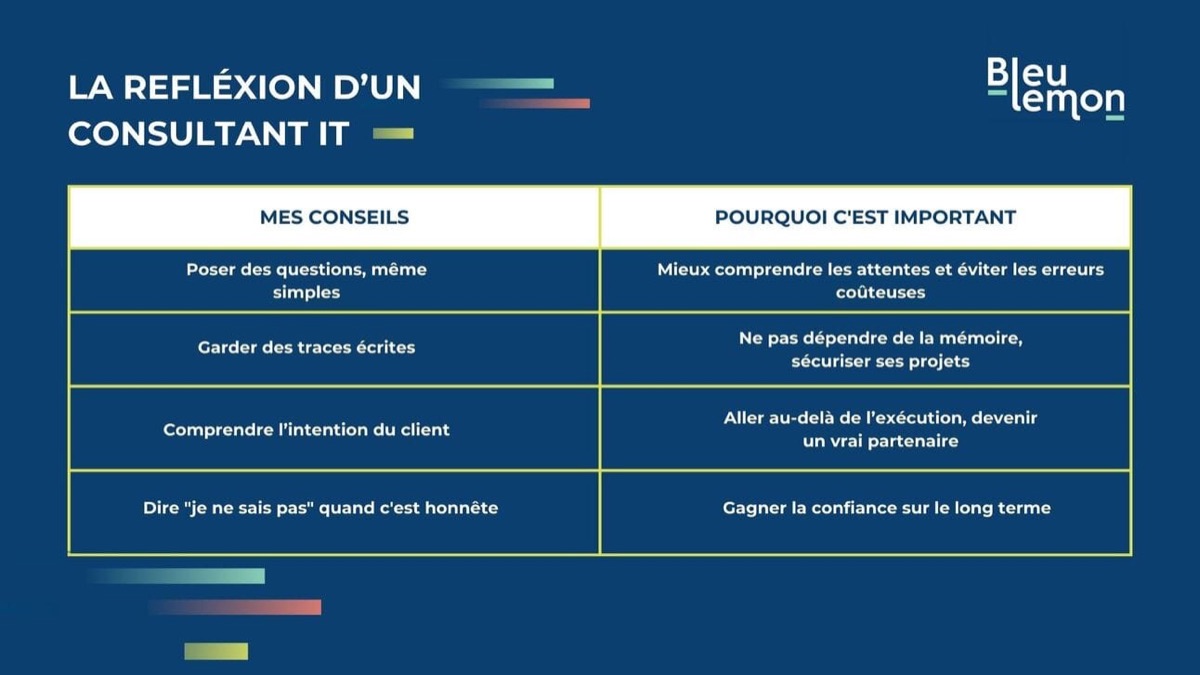
Consulting is a job you only really discover by practising it. The first engagements are often the hardest. You learn on the job, you doubt yourself a great deal and you improvise. My first engagement as an Atlassian consultant, at a large French insurer, was cut short: the client preferred another consultant after 1 day on site, a genuine failure!
Today, things have changed: juniors no longer go to a client on their own, we work in pairs, we choose engagements with more care. The support around consultants is more structured, and that makes all the difference.
Even though a client takes on a digital transformation consultant to implement their project “perfectly”, mistakes are also an integral part of our work, or at least of mine. Over time you learn to sense the potential difficulties, to avoid them, and to know how to react when you are in a delicate situation.
Eight years ago, when I inadvertently sent 17,000 Jira notification emails and saturated a great many inboxes, including the CIO’s, it took me weeks to shake off the shame. A proper, spectacular blunder. Now I listen to myself far more, and if an action does not feel right I take the time to think it through and analyse it with other people: together we often avoid the pitfalls (and at worst there will be several of us to blame!)
What I eventually came to understand is that you are never really an expert.
Tools change, expectations change, and so do the methods. Even after ten years, you find yourself faking it a little, for as long as it takes to get up to speed and grasp the new stakes. And in those moments, the most precious thing is the team. Knowing that you can call a colleague, ask a question without being judged, changes everything.
As I go on, I see two broad paths taking shape: specialising further and further, becoming a deep expert; or moving towards management, supervising juniors, running projects. Some change altogether, branching off towards other tools, other sectors.
Nothing is fixed, and the job evolves along with us.
What stays: the human relationship
Despite all these changes, some things in this job stay exactly as they were.
The human relationship, for one. That moment after a meeting when you have a coffee with the client, talk about holidays, relax a little. Those are often the moments that build trust, more than polished slides or up-to-date schedules. And yet for a long time I struggled with that part of the consultant’s work: the cigarette or coffee break did not appeal to me at all, the awkwardness of making small talk with someone I did not know, sheer dread!
Well, now I find it interesting, and I have realised that I often have far more in common with the person in front of me than I thought (a young child, a passing urge to try paragliding, a few years spent living in another country, trouble sleeping, and so on).
So there it is: after ten years, I do not claim to have understood everything, far from it. But I can say one thing: it is a demanding job that sometimes makes me a little anxious, and it is exceptionally stimulating. You have to enjoy the occasional discomfort, the permanent learning, and the grey areas. But if it suits you, and if you surround yourself well, then it really can be a great job!
What we can bring to your IT department
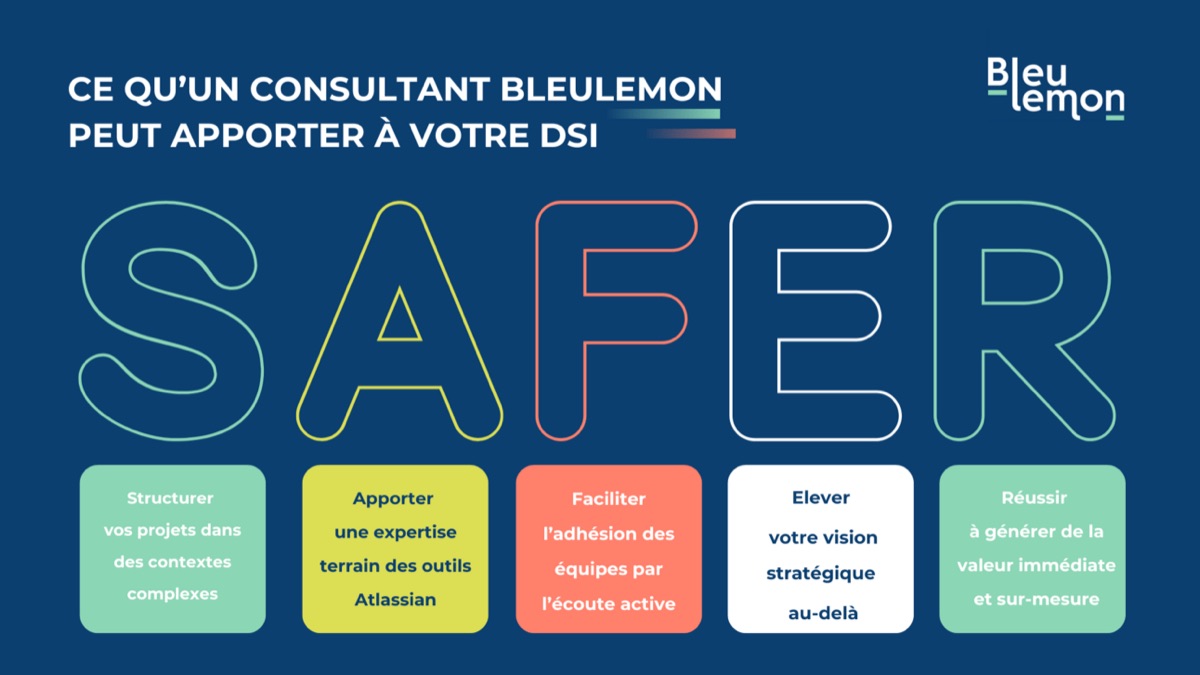
With 10 years of experience in digital transformation, I work alongside IT departments to:
-
Bring perspective and structure to complex or shifting contexts
-
Structure projects through hands-on knowledge of the Atlassian tools, and of the other tools on the market
-
Generate value quickly and adapt to your specific challenges, with a tailored approach, neither too rigid nor too vague
-
Make it easier for teams to come on board, through a posture of listening, collaboration and teaching
If you are looking for a hands-on consultant, able to secure your projects while building for the long term, talk to BleuLemon.
BleuLemon supports IT departments through their transformation with freshness, authenticity and commitment. We help organisations release the collective potential of their teams, opening the way to a more sustainable organisation of work.