

- A tool change, and a collaborative tool in particular, is a project that serves company culture and the unification of teams
- Involving users from the moment the solution is selected turns a constraining project into a unifying one
- Collaborative tools are especially effective in merger and acquisition contexts and where business functions are diverse
- Tailoring change support paths to each profile helps demonstrate that everyone counts in the organisation
- Collaborative technology does not only make work easier: it transforms human relationships and breaks down the walls inside the organisation
Implementing new digital tools has a major impact on the collective performance of teams.
Far more than a technical change, adopting a new software solution is a founding step towards unifying your teams and strengthening your company culture.
At BleuLemon, a consultancy specialising in the digital transformation of IT teams and in change support, the consultants guide transformations with a holistic and empathetic outlook that places the sharing of a vision at the centre of every project.
BleuLemon offers a transformation experience that is both reassuring and refreshing, freeing IT teams from fixed models so that collective intelligence can come through.
1. Understanding the human stakes of a technology tool change
Taking account of the psychological impact a tool change has on your employees is the cornerstone of successful change management.
Your team is not a monolithic block: it is made up of individuals with varied profiles whose reactions to novelty differ considerably.
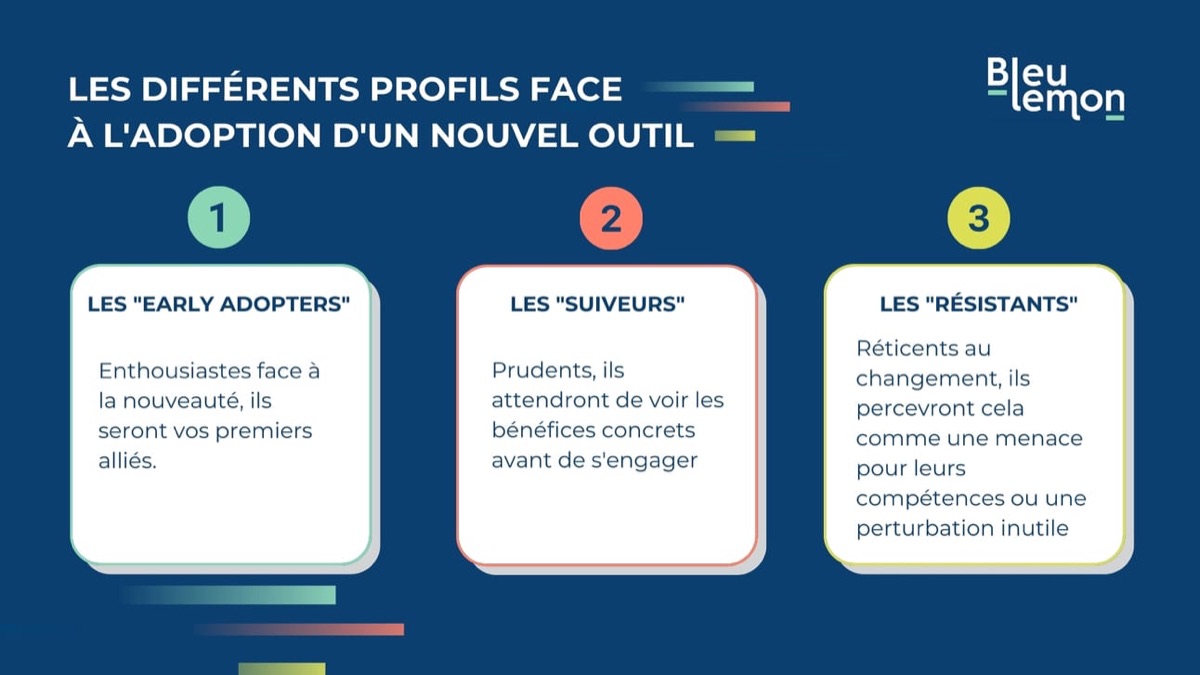
Within your teams you will generally meet three distinct profiles:
-
The "early adopters": enthusiastic about anything new, they will be your first allies
-
The "followers": cautious, they will wait to see concrete benefits before committing
-
The "resisters": reluctant to change, they will see the transition as a threat to their skills or as needless disruption
This diversity of attitudes can quickly fragment the team, at a real cost to the company: on one side the enthusiasts who move fast; on the other those who feel left behind or misunderstood and build up invisible technical debt. The task is to turn that heterogeneity into a collective strength in which everyone finds a place in the transition.
Without suitable support these divisions come at a high price: the project slows down, and technical debt settles in.
2. Preparing the ground: the foundations a tool change cannot do without
A successful transition starts with a precise assessment of current practice. Before you even consider a new tool, take the time to analyse how your teams work today. Listen to them: what are their methods, their friction points, their unmet needs?
This listening phase is the foundation of a successful transition. It brings the real underlying stakes to the surface.
Make sure as well that this change sits fully within the strategic vision of your organisation.
A new tool is never an end in itself, but a means of reaching wider objectives: better productivity, stronger collaboration, more secure processes...
The alignment between the chosen tool and your organisational ambitions must be explicit, shared and understandable by everyone.
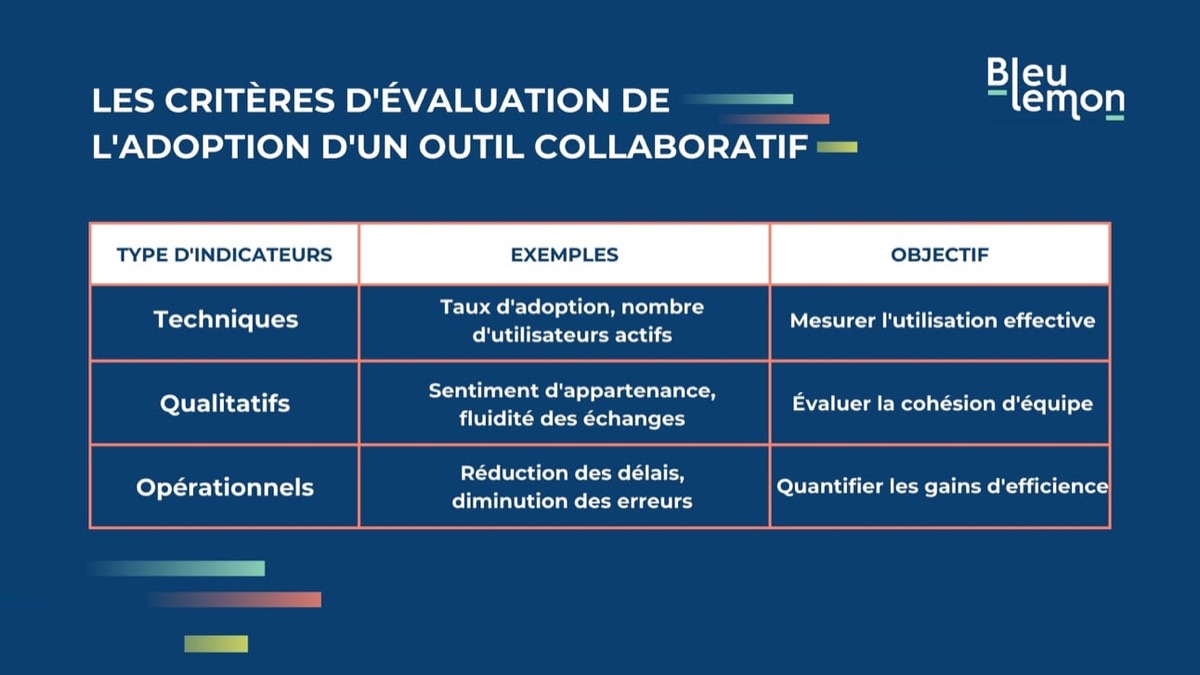
Finally, define shared and measurable success indicators.
Beyond the technical metrics, include qualitative criteria that reflect the impact on team cohesion.
3. Involving and uniting teams: the participative method
At BleuLemon we often observe that the digital transformation projects that fail are those where the tool was chosen unilaterally by management or by the IT manager.
Successful transitions, by contrast, generally rest on a "bottom-up" approach in which the future users are involved from the selection phase onwards.
One of the keys to success lies in creating a cross-functional team of "champions" drawn from the various departments and levels of seniority in the organisation. These ambassadors become the beating heart of the project.
The “champions” take part in the preliminary tests, and can pass on their colleagues' concerns while naturally becoming the first advocates of the solution chosen.
The results are genuinely telling when we put in place a continuous mechanism for collecting and folding in feedback. In practice, every suggestion or difficulty reported by users is documented, analysed and taken into account in order to improve the tool or its rollout.
This iterative approach allows the solution to be adjusted regularly, showing that employees' suggestions are not only heard but genuinely acted on.
That flexibility sends a powerful message: every voice counts, every contribution has value. This continuous improvement process, fed by the concrete experience of users, creates a sense of collective ownership that turns a simple technical transition into a shared adventure.
4. Avoiding the traps: supporting lasting adoption of IT tools
Several pitfalls can compromise a project meant to unify people through a tool change:
-
The disconnect between management and operations: leaders who are barely involved send a contradictory signal about how important the project really is
-
Underestimating training needs: a tool that is poorly mastered generates immediate, silent disengagement and finally complete abandonment, even when it is objectively high-performing.
-
The absence of continuous improvement: without regular optimisation processes, the risk of sliding back to the old practice is high.
Teams then return to the old solutions, creating parallel systems that fragment the data, compromise security and can cost several times the initial investment.
Plan enough time and resources for learning, and accept a transition period during which productivity may temporarily drop. Put in place regular rituals for reviewing and optimising the way the tool is used, so as to keep the collective momentum going.

5. Rolling out a new IT tool: an engine of unity
A successful rollout rests on transparent communication. The teams that come calmly through these periods of change are those where information moves freely.
Sharing progress regularly, acknowledging honestly the difficulties met and explaining how they are being handled creates a climate of trust that naturally heads off counter-productive rumours.
Training is another essential pillar, but its delivery gains from being adapted to each profile.
Some employees will thrive on a gradual introduction to the basic features, while others will want to master the advanced aspects quickly. Tailoring these paths shows consideration for the individuals inside a collective project.
The most memorable transformations are those where nobody waits for the end of the rollout to celebrate success.
Highlighting the small daily wins, valuing the progress made and recognising individual contributions creates a contagious positive momentum. These shared moments gradually weave a new collective identity around the tool, turning what was only a piece of software into a genuine social catalyst.
6. Collaborative tools that strengthen cohesion
Collaborative tools build real bridges between professional worlds that are sometimes very far apart and yet make up one and the same organisation.
In companies born of mergers or acquisitions, where teams with distinct cultures live side by side, putting in a collaborative platform acts as a powerful vehicle of unification.
Teams that until then mixed little are invited to enrich each other's practice around the everyday tasks.
Collaborative technology therefore does more than make daily work easier: it deeply transforms human relationships, opens up the information silos and creates the conditions for genuine collective synergy.
7. Case studies: concrete examples of successful transitions
1. Finding the balance between a common working framework and the expertise of the teams, in order to migrate from Redmine to Jira.
At a BleuLemon client in the energy sector, around a hundred people welcomed the plan to replace the backlog management software Redmine with Atlassian solutions. Divisions between the teams appeared quickly, however.
Everyone went their own way, insisting that team A did not work like team B. The Jira administrator, unable to arbitrate between the different workflows and the new task fields without knowing the specifics of each team, reached a dead end.
The solution emerged from a simple principle: respect the expertise of the teams while imposing a unified framework.
"We are not the ones who know how people should work, they are. But we do require that everyone works in the same way."
Three collaboration rules defused the resistance of the users:
-
Comparing initiatives in order to progress together
-
Smoother internal mobility
-
Standardised indicators for management
By bringing the Scrum Masters together in a co-construction space, the new collective designed a simplified process that everyone accepted.
Tensions dropped significantly.
A perfect illustration of the balance between autonomy and collective consistency.
2. When technological adversity forges unity. An example of a migration from Lotus Notes to Atlassian, at a financial software publisher.
This other BleuLemon client set out to migrate years of history from Lotus Notes to Atlassian. That digital transformation project concerned 1000 people, and the cultural change challenge was even greater than the technical one.
"It was like Koh-Lanta: the yellows, the reds and the whites. The teams that came from the different acquisitions were not talking to each other."
Paradoxically, it was the anxiety about the change that catalysed the first interactions. The teams focused on the tool. They began to work together to find a common solution. The Atlassian solutions Jira and Confluence were kept, and more importantly still, people were working together.
The tool became the symbol of a shared identity, turning the initial fear into collective pride.
Proof that a technological change can become a powerful catalyst of unification, particularly in contexts where cultural identities have been weakened.
Conclusion
By giving collective intelligence pride of place, from the moment a new tool is chosen inside your IT department, you turn a simple software transition into a powerful catalyst of cultural transformation.
Successful team unification is not measured only by the technical adoption of the tool, but by its capacity to:
-
bring new synergies to the surface,
-
break down the walls between departments,
-
instil a renewed sense of collective belonging.
Beyond the one-off implementation, what you are establishing is a whole culture of agility and continuous improvement, preparing your organisation to stay competitive in its market, equipped with a culture of innovation that will let it face uncertainty.

BleuLemon supports IT departments through their transformation with freshness and quickness of mind. We help organisations release the collective potential of their teams, opening the way to a stronger and more fulfilling organisation of work.