

- A service catalogue is a reference point: it must state clearly what is available and on what terms.
- The wording must be accessible: your users are not IT experts, and it is not their job to guess.
- A good tool is not enough: without change management, the experience stays confusing and frustrating.
- Not every service is self-declared: some requests have to be requalified by the IT department.
- A frozen catalogue is an out-of-date map: it has to live and evolve alongside your services.
- EDF Solutions Solaires case: a JSM Data Center portal with Assets as the catalogue repository; Azure AD SSO & SCCM integration.
Your service catalogue must make your IT services clear, so that users find it easier to raise requests. Make your portal readable, traceable (SLAs and approvals) and intuitive for your users.
BleuLemon is an Atlassian Platinum Partner and can support you in defining your catalogues in every technical environment.
In every ITSM project, there comes a moment when we have to address the notion of the service catalogue. And that is exactly the moment when I realise that, although the term is familiar to our clients, putting that service catalogue in place while avoiding the possible pitfalls is fairly delicate, even difficult.
Yet clients are reluctant to get support with it.
In this article, we explain how our support can help you. A well-built service catalogue delivers a gain in operational efficiency and a positive perception of value among your users.
1. What is an IT service catalogue for?
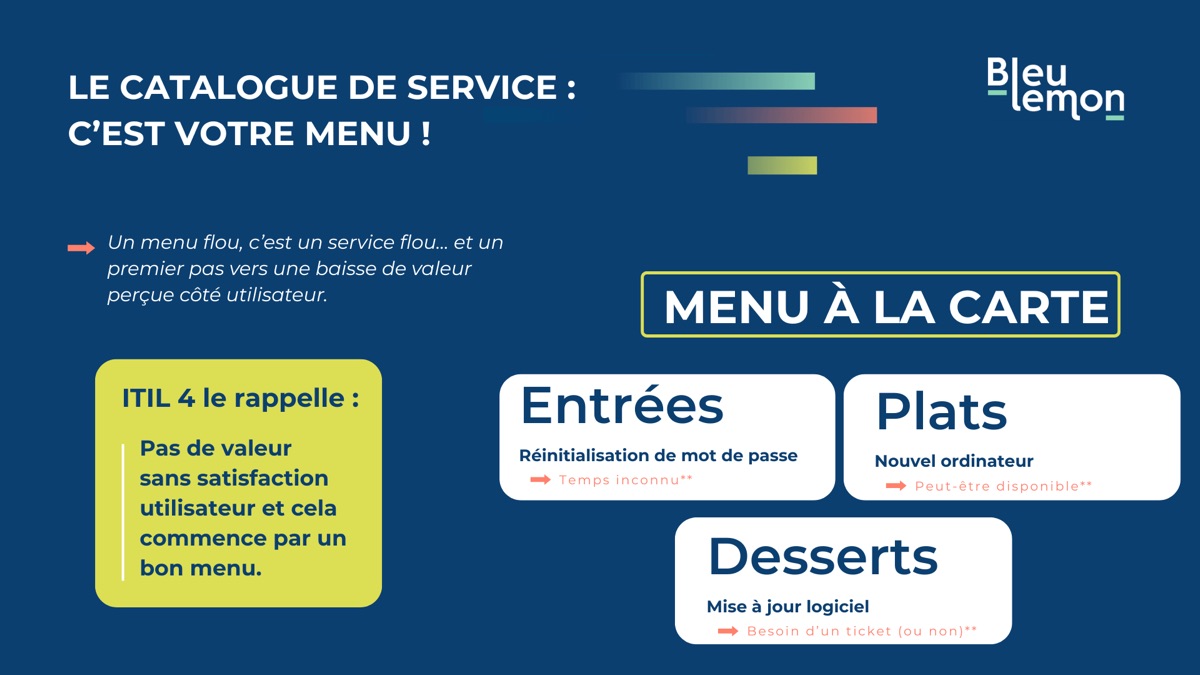
To draw an analogy, the service catalogue is the equivalent of the menu in a restaurant.
In a restaurant, the customer needs to know what they can ask for once they are seated at the table. The menu acts as the shop window, and the customer can read it before ordering. If they want to eat a burger, they are not going to walk into a sushi restaurant.
In the same way, in your organisation, building a service catalogue means presenting the menu to your users, so that they know exactly what they can and cannot ask for. This matters all the more when you recharge costs internally. To go back to the restaurant analogy, you certainly will not order the most expensive dish on the menu if you do not have the budget for it, and you will not order the most filling dish without the appetite for it. It is the same for your IT services when you recharge them.
The service catalogue is a tool of the IT department, used to present the services delivered, the associated costs and the resolution times for requests. It is one of the communication tools you address to your users, and that is why you must not fall into certain pitfalls, all the more so when you have to transpose it into a tool.
Client story: EDF Solutions Solaires
An evolving service catalogue in 1 month: A JSM project set up at short notice with an evolving service catalogue, which made it possible to keep it up to date over the long term.
Read the case study: From EasyVista to Jira Service Management, the strategy of EDF solutions solaires
What you gain
-
Greater autonomy for users and shorter handling times (SLAs met)
-
Less scattering: more targeted requests
-
Clear governance: the repository in place is clear, service owners are identified, and updates to the components of the services are traced (service versioning).
2. Bringing your service catalogue into an ITSM tool: the pitfalls to avoid
What your users do not tell you (but think very loudly)
Many of our clients think the exercise is easy and fall into some of these “pitfalls”, and we often hear remarks of this kind:
-
“You need an engineering degree to ask for a mouse”
-
“When you raise a request, it is a lottery: sometimes I get what I ask for, sometimes I do not”.
-
“No user is capable of qualifying their request properly”
Taking each of these remarks in turn:
“You need an engineering degree to ask for a mouse”
→ What this remark means is that the service catalogue is nowhere near within everyone's reach. A user with no technical background may struggle to grasp the service catalogue and its structure. You have to keep it SIMPLE!
When you raise a request it is a lottery, sometimes I get what I ask for, sometimes I do not:
→ Here the issue has more to do with the process hiding behind each request a user may raise. The IT department has to communicate! On a hardware request, typically, it is important to communicate about the approval processes that may be in place. If the user thinks they are shopping as they would on Amazon, the truth is quite different: every hardware request may be subject to several levels of approval, from the manager and from the business unit or entity.
No user is capable of qualifying their request properly
→ You can ask a user to qualify their request, but only up to a point. In a service catalogue, some entries are accessible and understandable to everyone (provided your service catalogue is well built! 😉 ) but some entries are genuinely specific to the IT teams, and never, ever will the end user be capable of selecting that level in the catalogue.
Designing a catalogue that speaks to everyone: our 4 fundamentals
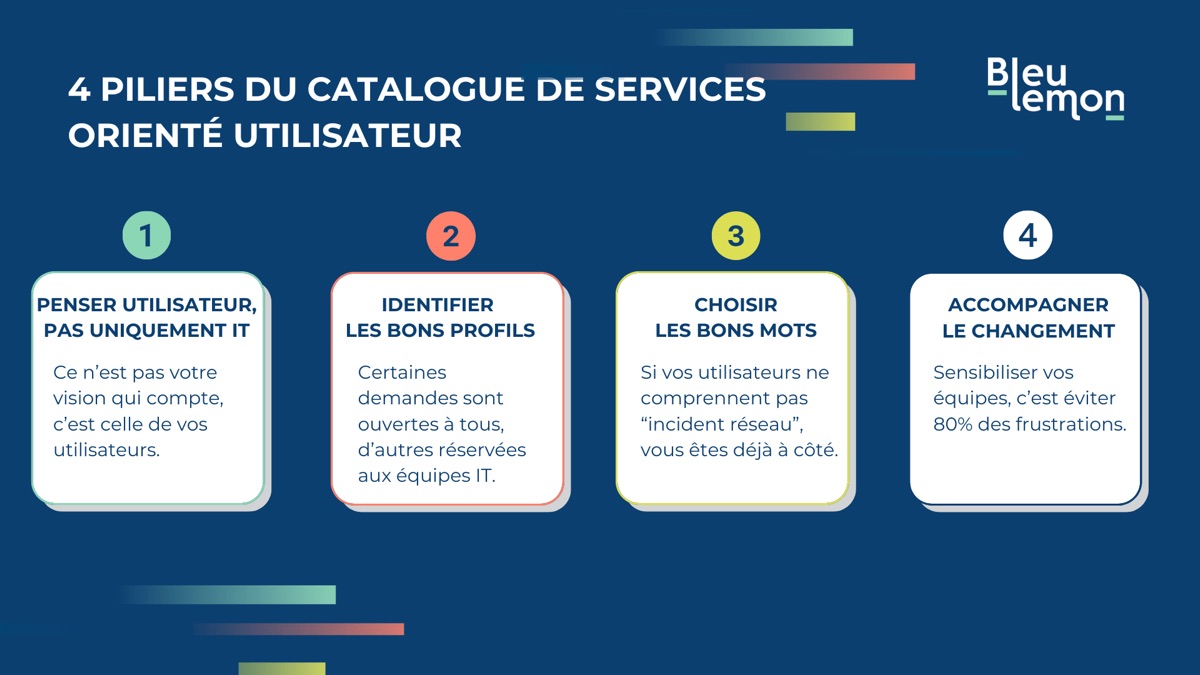
BleuLemon's 4 pieces of advice for avoiding this kind of pitfall:
-
The service catalogue must speak the user's language: when we design the service catalogue inside the IT department, we bring our IT view and we find it hard to put ourselves in the end user's shoes. Designing an IT version of your service catalogue as a first draft is a good start, but you absolutely must bring it back to the user's level before making it available in your ITSM tool. In short, you have to design an IT service catalogue for end users, in IT and in the business. And that exercise is far from simple! Take it from my 10 years of experience on the subject 😉
-
You need to identify the audiences the service catalogue is aimed at: some entries will be visible to everyone and some will be restricted to the back-office teams, since they alone will be able to qualify the ticket properly. In short, you can let the user do part of the job, but you also have to accept that requalifying the ticket, or completing its qualification, is part and parcel of the IT department's remit.
-
The choice of words matters: if I give you “Network incident” as an example, everyone on the IT side has an idea of what may sit behind it. But on the user side, will they connect “network” with wifi, VPN or firewall? I can assure you that, however much confidence you place in your users, not all of them understand everything you offer in your service catalogue.
-
Change management supports gradual adoption and the transition: it can never be said often enough, but communication and closeness to the user is one of the watchwords for the success of a project and for getting to grips with a tool like this one. When the service catalogue is transposed into your ITSM tool, it is important to make users aware of what they can ask for and how to ask for it. With that alone you have defused 80% of your users' negative thoughts. 😉
Bonus: measure your IT catalogue and keep it alive, so the shop window keeps evolving
- Portal usage KPI: volume of tickets created through the portal versus through the other channels
- Share of requests handled within the agreed times versus outside them.
- A review loop (monthly or quarterly) to archive what is no longer used and revise what is.
Communicating also means giving people responsibility and clarifying how services are used, to avoid the negative pitfalls and maximise value in the eyes of the user. And value in the eyes of users means service quality perceived positively.
And that is the jackpot, since the purpose of a company is to create value for its users and its stakeholders.
Catalogue governance makes sure that what is offered is properly described, maintained and communicated.
3. The service catalogue: a tool that needs updating regularly
Why update your IT service catalogue regularly?
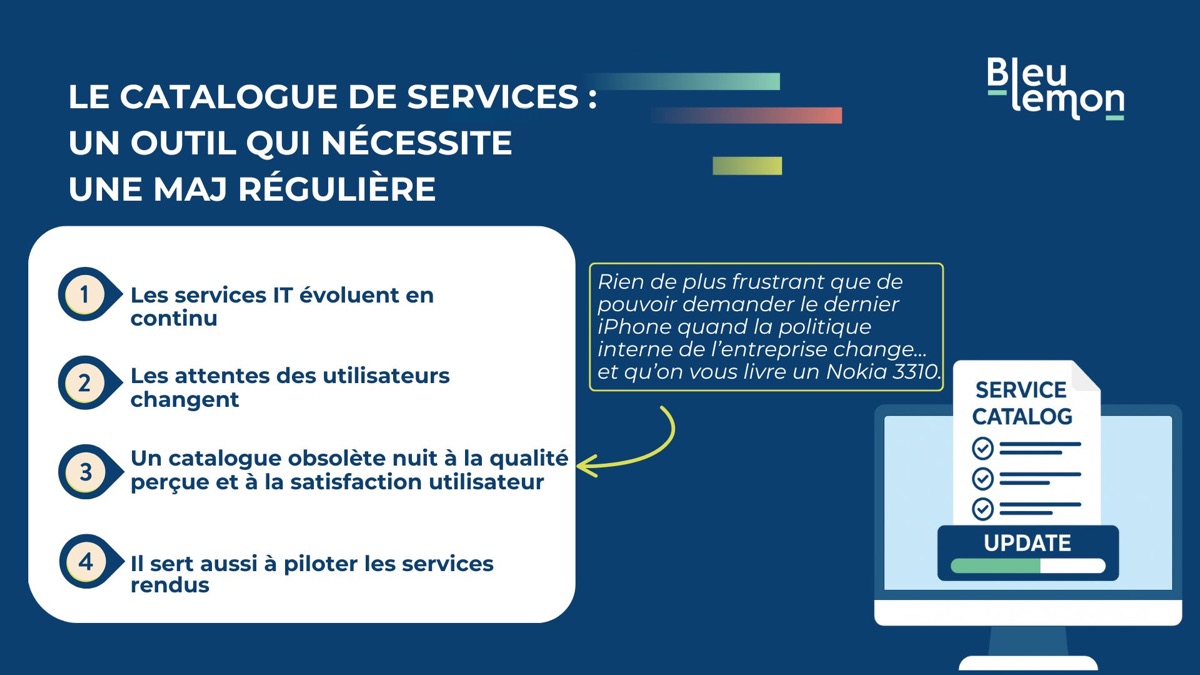
A service catalogue is not a “one shot” exercise! It will live on: new services will be offered, others will be withdrawn or updated.
Remember the restaurant image: nothing is more annoying than walking into a restaurant because the menu in the front window appealed to you, then being handed a menu at the table that bears no relation to what you saw outside. For the service catalogue, it is the same thing. Users must know at every moment what they can ask for and on what terms. Any lapse could have negative repercussions on how users perceive the value you offer them.
And the major objective of an IT department is this: to deliver top service quality along with the satisfaction of its users.
IT departments, look after your image 😉
Who has never heard it said that IT is of no use, and then, the day something stops working, realised that it is actually rather useful. You can change how your users see you!
BleuLemon, a partner to turn your service catalogue into a lever for value
BleuLemon, an Atlassian Platinum Partner, equips the governance of IT departments without jargon or friction. Drawing on our field experience, we do not leave aside how well users understand things. We have put in place and challenged a good number of service catalogues. BleuLemon can therefore help you:
-
to design your service catalogue while avoiding the classic pitfalls,
-
to turn an IT service catalogue into an IT service catalogue aimed at end users,
-
to improve the user journey by making your catalogue available in ITSM tools,
-
to challenge your service catalogue in order to improve your teams' operational efficiency.
In short: as in a restaurant, why should you have to choose between starter + main OR main + dessert (consulting OR implementation), when you can have starter + main + dessert (and therefore consulting AND implementation).