
- IT department budgets are rising and they are watched more and more closely. The main challenge is to move from a cost control mindset to a value management mindset
- If budgets are rising, it is often because they carry the transformation of the business and cloud optimisation, not because they are running out of control.
- The main challenge is to move from a cost control mindset to value management.
- Budget scrutiny is a strategic opportunity: the IT department is recognised as a central element of the performance and the sustainability of the business.
ITFM/FinOps, DevOps and ITSM practices help clarify IT spending and connect it to the value the IT department creates.
1. The (not so) weak signals from the field
The same trend shows up at many of our large-account and mid-sized clients: the IT department is increasingly asked to justify its costs. And as a consulting firm dedicated to IT department transformation, we at BleuLemon feel it particularly keenly.
Have you already heard these questions?
“Why does 15% of the overall budget now go through the IT department?
What is the business justification for this spending?
2. Why the IT budget is rising
What is driving the trend
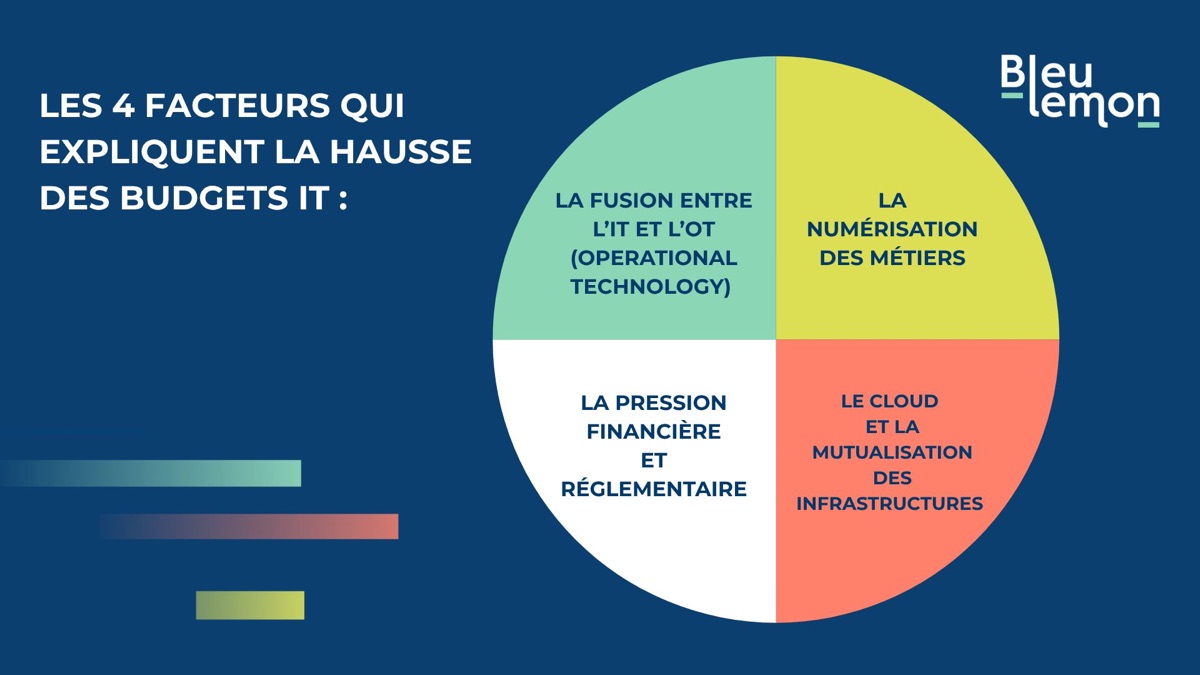
Four main causes drive the rise in IT budgets:
-
the digitisation of business functions
-
the Cloud and the pooling of infrastructure
-
The convergence of IT and OT (Operational Technology)
-
Financial and regulatory pressure
It can also be added that pay-as-you-go consumption of the public Cloud can alarm the finance department if it is poorly controlled. The difficulty of observability and log monitoring amplifies that concern.
Businesses are going digital, and faster and faster. Yet digital budgets are traditionally assigned to the IT department. This rise in budgets therefore comes more from a transfer from other departments towards the IT department than from a structural rise in the costs of the IT department itself.
This digital transformation calls for new tools: managed services, dynamic scaling of resources; Kubernetes skills, for a mature DevOps approach, and FinOps skills to make per-service costs visible in a public Cloud context.
An example: the media sector
The technical department of a media group often has its roots in production, distribution, broadcast, video signal, hardware equipment and control-room infrastructure. The IT department was often born later there, in the years 1980-1990, and initially to look after the information system, the servers, the networks, the applications, the IT estate and so on.
The technical department was organised around service continuity (live broadcasting, signal, latency, and so on), around media quality issues and around the maintenance of specialised hardware, while the IT department looked after internal systems, computing, application integration, the user estate and data governance.
It came “after” in the technological evolution. It had an IT and computing culture, while the technical department had a “broadcast and hardware engineering” culture.
Today that separation is fading. In 2019, RadioFrance referred to a “Direction Technique et Système d’Information (DTSI)” that brings together functions which had until then been distinct.
The same trend observed in other sectors (banking, manufacturing, healthcare)
The media are not the only sector concerned by this shift. Other examples exist:
-
Banking and financial services: according to a Deloitte study, IT “is becoming central in helping to build new business models”, with KPIs specific to digital platforms and TCO management by customer service.
-
Manufacturing industry: this industry, although traditionally focused on equipment, production lines and mechanical systems, is seeing a growing push towards digitisation (IoT, predictive maintenance, data platforms). Even if IT spending in this sector remains modest as a percentage of total spending, it is growing.
-
Healthcare: this sector is digitising fast. Electronic patient records, telemedicine, AI for diagnosis, and so on. Many tasks entrusted to biomedical equipment are migrating towards IT services and the IT department.
-
Transport, logistics, mobility: connected systems, smart fleets, predictive maintenance and Cloud-IoT platforms are moving technical budgets for vehicles and infrastructure towards IT, data and automation platforms.
Previously, because the IT department budget was proportionally smaller than it is today, it was less closely examined. Today it receives particular attention.
These transformations call for a specialised cloud audit and a FinOps approach adapted to regulatory constraints.
What if this were good news?
Technology investments are easier to monitor when they are centralised in a single place. The traceability and tracking effort can be placed on the IT department instead of having to be consolidated from different sources.
The same goes for optimising resources.
Centralisation also reduces the silos between business-side engineering and IT, and therefore produces an architecture that is more coherent and so more maintainable. Breaking down those silos opens the way to faster innovation and to better cross-functional governance.
The IT department becomes a strategic co-pilot. It is less and less a support function and more and more a lever for innovation and performance, whose value and ROI can be demonstrated through precise KPIs and an alignment between IT, Finance and the business.
Setting up an ITFM approach: where to start?
Because the IT department now concentrates budgets that come from other perimeters, it has to justify the value it creates by relying on practices such as:
-
internal recharging (showback/chargeback),
-
managing TCO (Total Cost of Ownership) by service,
-
measuring the business ROI of technology projects,
-
setting up a regular cloud audit and a structured FinOps approach,
-
implementing observability and monitoring tools for real-time steering.
These practices are widely described in the ITSM, DevOps, ITFM and FinOps frameworks. They benefit from mature tooling (Atlassian, IBM/Apptio for example) backed by documented, proven methods (TBM, ABC, and so on). The transfer of investment towards the IT department has to be anticipated, accelerated and prepared for: developing IT skills, putting global governance in place, aligning strategy and budgets.
Be careful, however, not to forget that business-side technical departments remain indispensable, above all for critical and specialised equipment. The point is not to replace the technical department, but to rebalance responsibilities and budgets with a stronger alignment between IT, Finance and the business.
And of course, this implies a change in culture, in skills and in governance. These transformations are what we live through every day with our clients.
Let us never forget that the engine of any transformation is still the team!